
Introduction to Latin: Teaching Morphology the Wired Way: How to Use Guided Discovery and Adapted ASL to Teach Latin Morphemes
Description
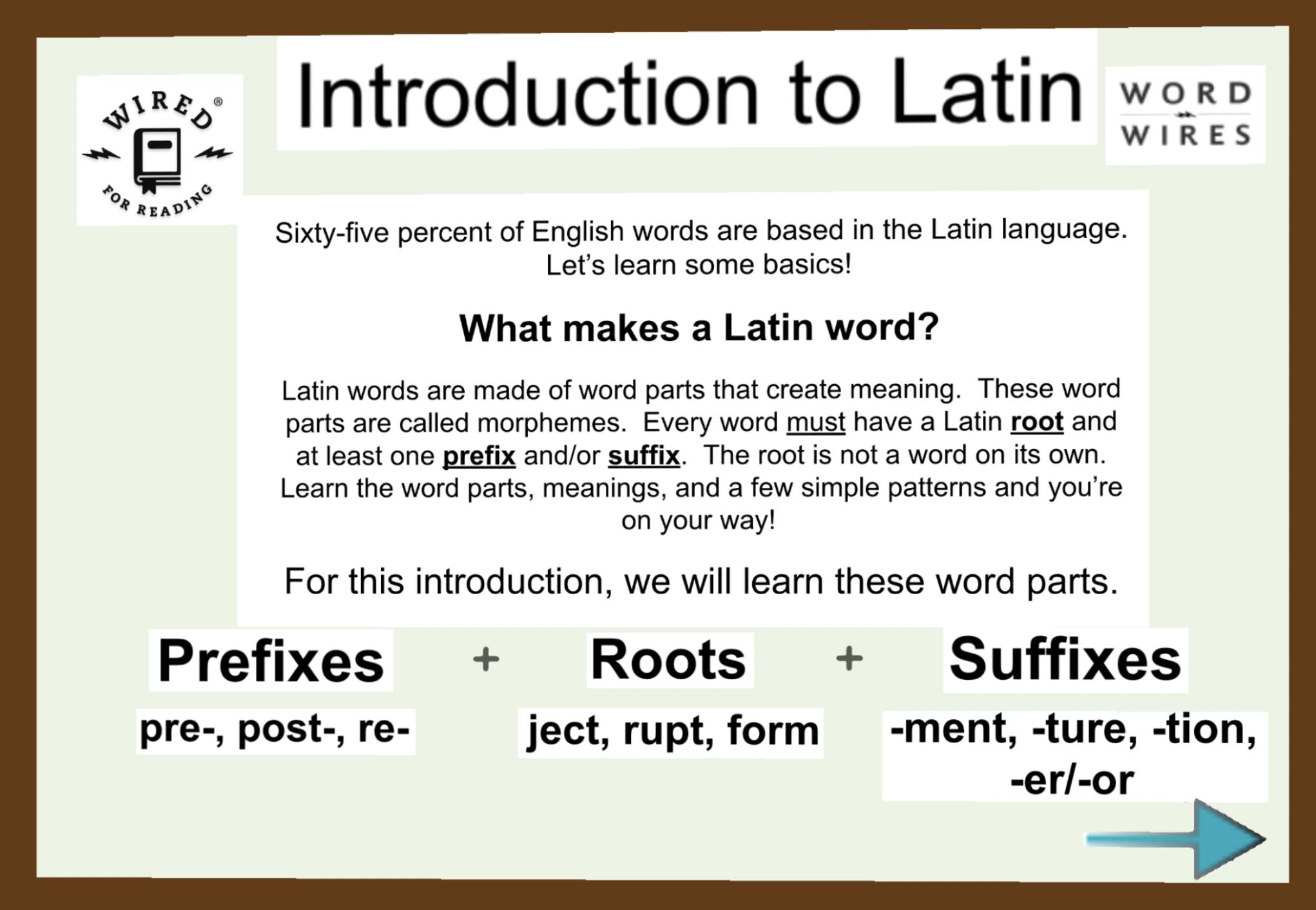
The goal of this activity is to provide educators with the tools needed to start using the intuit strategy and Adapted American Sign to learn a few of the most common Latin prefixes, roots, and suffixes. Latin-based words are meaning puzzles that use the same meaning parts over and over in different combinations to make words. Knowing the most common Latin prefixes, roots, and suffixes helps us read, spell, and understand Latin based words. The intuit strategy helps us figure out the meaning of Latin word parts (morphemes) while the Adapted American sign helps us remember them. If you want to learn more, please check out our Wired for Reading Advanced course. Students with Dyslexia and other language processing differences struggle to memorize information using traditional teaching methods but often excel at learning, remembering, and using ASL to hold onto information. Adapted American sign puts meaning into the body, wakes up the brain, and acts as a conduit, connecting the prefix/root/suffix to its meaning. It is also engaging and can easily be converted into cues to help students transfer this knowledge to independent reading and writing. By explicitly teaching the meanings, pronunciation, and spelling patterns of Latin-based morphemes, students independently read and spell more quickly and efficiently. Students learn to spell it like it means and not just how it sounds.